

SEO isn’t one thing—it’s a toolbox. This guide organizes 40 types of SEO into four practical buckets so you can pick the right tools for your site, industry, and growth stage.
1) Core Pillars of SEO
Every strategy is built on three pillars. Nail these first.
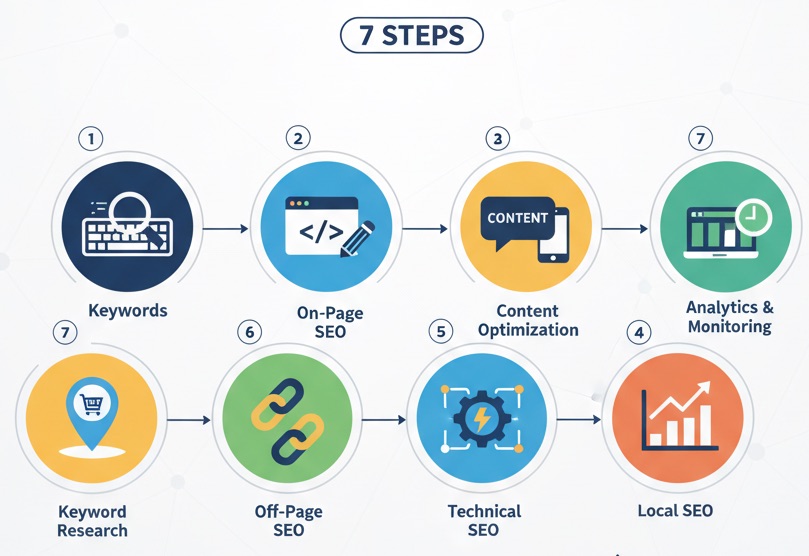
- On-Page SEO — Optimize content and HTML on each page: titles, H1s, copy, internal links, media, and schema. KPI: rankings & CTR for target queries.
- Off-Page SEO — Build authority with links, mentions, PR, and brand searches. KPI: referring domains, branded impressions, and E-E-A-T signals.
- Technical SEO — Make the site crawlable, indexable, and fast: sitemaps, robots.txt, canonicalization, Core Web Vitals, structured data. KPI: index coverage and page experience.
2) Search Types & Formats
Search isn’t just 10 blue links. Different surfaces require different optimizations.
- Mobile SEO — Responsive design, fast LCP/INP, mobile navigation.
- Voice SEO — Conversational queries, FAQ markup, snippet-ready answers.
- Video SEO — Titles, descriptions, chapters, transcripts, VideoObject schema.
- Image SEO — Descriptive filenames, alt text, lazy-loading, image sitemaps.
- Content SEO — Search-led content planning: intent, entities, internal links.
- News SEO — Publisher guidelines, freshness, structured data, Top Stories eligibility.
- AI Chatbot SEO — Entity clarity, source trust, summary-friendly formatting for AI overviews and assistants.
3) Business-Type SEO
Tailor your strategy to how (and where) you sell.
- Local SEO — Google Business Profile, NAP consistency, local citations, reviews, and location pages.
- International SEO — Hreflang, geotargeting, currency/language UX, regional SERP research.
- Multilingual SEO — High-quality translations, localized keywords, separate URLs per language.
- Enterprise SEO — Governance, scalable templates, automation, cross-team change management.
- Ecommerce SEO — Faceted navigation control, product/Offer/Review schema, categories, internal linking at scale.
- Affiliate SEO — Comparisons, reviews, product data accuracy, trust signals, and compliance.
4) SEO Tactics & Approaches
How you execute matters. Pick sustainable, user-first methods.
- White Hat SEO — User-value and guideline-compliant. Long-term compounding results.
- Gray Hat SEO — Borderline tactics with risk. Use caution.
- Black Hat SEO — Manipulative methods that invite penalties. Avoid.
- Parasite SEO — Publishing on high-authority third-party domains. Consider platform rules and reputation risk.
- Brand SEO — Grow branded search, navigational demand, and reputation.
- Accessibility SEO — WCAG-aligned UX; alt text, headings, contrast—great for users and discoverability.
- Programmatic SEO — Template-driven pages at scale (e.g., locations, specs, variations) with strict quality control and deduplication.
5) Platform-Specific SEO
Search happens across ecosystems. Optimize where your audience lives.
- Google Discover SEO — E-E-A-T, engaging thumbnails, timely topics.
- Google SGE (AI Overviews) — Clear answers, sources, entities; digestible sections.
- Amazon / Etsy / eBay SEO — Marketplace-specific attributes, reviews, conversion rate.
- Shopify SEO — Collections, product schema, URL hygiene, speed, internal links.
- App Store SEO (ASO) — Titles, keywords, screenshots, ratings.
- Podcast SEO — Episode titles, show notes, transcriptions.
- Reddit / Quora SEO — Helpful participation, source citations, community trust.
- YouTube / TikTok SEO — Keywords in titles, descriptions, hashtags, chapters; strong watch metrics.
- LinkedIn / Pinterest SEO — Hashtags, alt text, link strategy, save/share behavior.
- Google Maps SEO — Categories, photos, reviews, proximity, local content.
- Tripadvisor SEO — Listings completeness, reviews, seasonal content, Q&A.
How to Choose Your SEO Mix
- Define outcomes: traffic, revenue, leads, or footfall?
- Map to pillars: fix technical debt, then on-page, then authority.
- Match search types: do you need video, images, or local?
- Align to business type: local vs. international vs. ecommerce vs. enterprise.
- Pick 1–2 platform plays: e.g., YouTube + Google Discover for education, or Google Maps for local.
- Measure smart: track rankings, CTR, conversions, and retention—avoid vanity metrics.
Tip: Revisit your mix quarterly. Sunset what doesn’t move KPIs; double down on winners.